A & R Scouts Nashville
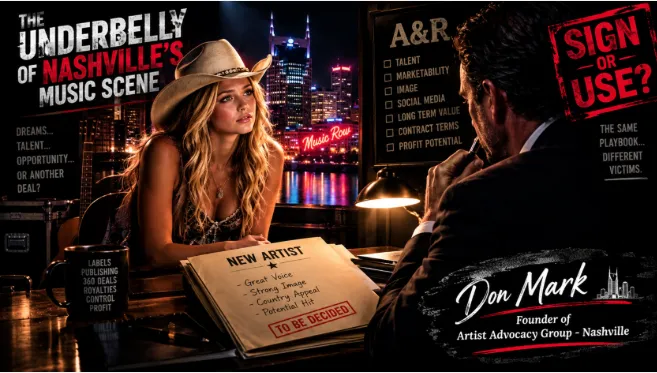
What to watch out for. Avoid engaging with lying predatory A & R reps
who can and will not help you.
IN OUR SERIES OF EBOOK FIELD GUIDES YOU WILL FIND EXTENSIVE LISTS OF
NAMES OF LEGITIMATE A& REPS
The first distinction matters: a legitimate A&R rep and someone calling themselves an “A&R” are not the same thing. A&R at a real label or publisher is primarily a talent/repertoire function—finding artists and songs, evaluating whether they fit the company, helping develop them, and connecting them with producers, songwriters, managers, and internal decision-makers. Nashville A&R executives themselves describe the job as highly competitive and increasingly focused on artists who are already demonstrating an audience and a viable identity.
The ugly side is that “A&R” is an attractive title for people who want access to aspiring artists. The FBI Nashville specifically warned in 2026 that Nashville music-industry professionals are being targeted by advance-fee, non-delivery, overpayment, extortion and impersonation scams. In its reporting period, 107 music-industry professionals reported advance-fee/non-delivery/overpayment scams totaling $777,063.
Problems country artists in Nashville should watch for
The “pay me and I’ll get you signed” pitch.
This is the biggest red flag. A person says they have label connections, can “get your music in front of A&R,” or can arrange a signing—
but wants $500, $1,000, $5,000, etc. for the privilege. Don't confuse legitimate professional expenses
with paying someone for access. If the central proposition is give me money and I will get you a record deal,
walk away.
Fake or unauthorized A&R. IMPORTANT DON'T SKIP
Someone may genuinely work somewhere in the industry—or may have worked there—but that doesn't mean they have authority to sign artists or speak for a label.
There are documented cases of paid showcases advertising access to supposed
A&R people where the artists pay for the opportunity, while the people in the room don't actually
have signing authority.
“Showcase” businesses selling the dream.
You pay to perform one or two songs in front of supposedly important industry people.
You're told this is your chance to be discovered. Sometimes it's legitimate networking.
Sometimes it's essentially paying for the illusion of being discovered. One documented
Nashville-related example involved artists paying hundreds of dollars to perform while
the supposed A&R presence was part of the sales pitch.
The “your music is great, but…” money trap.
This one is particularly nasty because it can sound professional:
“We love you, but your demos aren't quite there.”
“You need our producer.”
“You need to record at our studio.”
“You need professional development.”
“We can make you label-ready.”
Suddenly you're paying the same person who supposedly discovered you for
studio time, production, development, consulting, marketing, etc.
Nashville has had longstanding warnings about versions of this bait-and-switch, particularly where publishing/song-plugging opportunities are used to sell artists expensive demos.
Vague promises instead of an actual deal.
“We're going to work with you.”
“We're going to introduce you to some people.”
“You're basically on our roster.”
“We're getting the paperwork together.”
None of those statements necessarily mean anything.
Ask what the actual business relationship is. Are they representing you? Developing you?
Shopping you to labels? Signing your recordings? Publishing your songs? Consulting?
Managing you?
Using your desperation against you.
This is probably the biggest psychological problem.
The artist hears:
“You're almost there.”
That phrase can keep someone spending money for months or years.
A legitimate professional can tell you why they aren't signing you. A predator keeps the
carrot in front of you.
Taking control of your rights before you've earned anything.
Be extremely careful about contracts involving:
master recordings
publishing
songwriting percentages
exclusive recording rights
management
options for multiple albums
perpetual rights
name/image/likeness
merchandise
administration rights
Getting “signed” isn't automatically winning. A terrible contract can be much
worse than no contract.
Confusing industry connections with actual results.
Someone saying:
“I know people at Sony/Universal/Warner.”
means almost nothing.
Ask:
Which people? What did you actually accomplish for the last artist?
If they have a legitimate track record, they should be able to explain it without relying
entirely on famous names.
The “you need to build your following first” problem.
This one is more complicated because it's often legitimate advice.
Modern A&R really does look at whether an artist has an audience.
A Nashville A&R guide published in 2026 describes reps emphasizing audience development
and artist identity rather than treating A&R as a lottery where someone simply discovers an unknown artist.